Sunday, April 9, 2017

Sunday, April 2, 2017
My Favorite Sporting Upsets and Underdog Stories
Mississipi State's 66-64 victory over UConn in the Women'sFinal Four on Friday night had all the ingredients of a great upset. A David, a
Goliath, a big stage, and an overtime buzzer beater to add a little zest.
 These moments may be fleeting, but they make some of the best
memories. Moments
like these are what make all the countless hours of watching, all the anxiety-induced vomiting, and all the missed homework deadlines worth it.
These moments may be fleeting, but they make some of the best
memories. Moments
like these are what make all the countless hours of watching, all the anxiety-induced vomiting, and all the missed homework deadlines worth it.
So long after the crowds had undoubtedly dissipated from the
stadium to the bars, from the bars into the Dallas hotels, after America's adrenaline
had returned to its normal levels and the commentators were done thanking Ross
Dress for Less for providing their wardrobes; after I had brushed my teeth,
taken my Flinstones vitamins, and my mom had tucked me safely into my Steve
Urkel sleeping bag, I lay awake in bed, thinking long and hard about these rare
moments.
I began to ponder: What is the best sports upset of all time? As I lay
there in my dimly lit bedroom, staring at the glow-in-the-dark Richard Simmons
poster that hangs over my bed, I composed a list of my favorite upsets and
underdog stories. Mississippi's win rolled in at the number five spot. Here are
my four others:
3. "Rocktober"
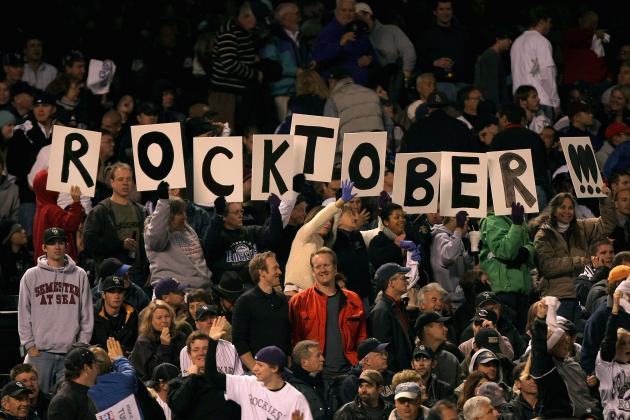 No Colorado sports fan can forget the Colorado Rockies'miracle run to the World Series in 2007. While it didn't end well for the
Rockies, getting swept in the World Series by the Boston Red Sox, the journey
there was a fun and memorable one for the Colorado community. The Rockies
finished that regular season by winning 13 of their last 14 games, defeating
San Diego in a play-in game to take their spot in the playoffs. They swept
Philadelphia in the NLDS and Arizona in the NLCS to finally advance to the
World Series.
No Colorado sports fan can forget the Colorado Rockies'miracle run to the World Series in 2007. While it didn't end well for the
Rockies, getting swept in the World Series by the Boston Red Sox, the journey
there was a fun and memorable one for the Colorado community. The Rockies
finished that regular season by winning 13 of their last 14 games, defeating
San Diego in a play-in game to take their spot in the playoffs. They swept
Philadelphia in the NLDS and Arizona in the NLCS to finally advance to the
World Series.  Ronda Rousey's 12-0 record wasn't the only thing that made
her heavily favored in her bout against Holly Holm in November 2015. It was the
manner of her victories that had many people thinking she was unbeatable. With
her previous three opponents lasting just 34, 14, and 16 seconds against her,
some fans were even speculating that the UFC Bantamweight champ could beat
Floyd Mayweather in the cage. So when world champion boxer Holly Holm knocked
Rousey out a minute into the second round, the mma world was in shock.
Ronda Rousey's 12-0 record wasn't the only thing that made
her heavily favored in her bout against Holly Holm in November 2015. It was the
manner of her victories that had many people thinking she was unbeatable. With
her previous three opponents lasting just 34, 14, and 16 seconds against her,
some fans were even speculating that the UFC Bantamweight champ could beat
Floyd Mayweather in the cage. So when world champion boxer Holly Holm knocked
Rousey out a minute into the second round, the mma world was in shock.
This was
one of my favorite upsets because I was one of the few people who thought Holm
had a chance, and because it silenced Rousey's obnoxious fans.
My all time favorite sports upset, though, has to be Rulon
Gardner's upset of Russia's Alexandr Karelin in the 2000 Olympics for the gold
medal in Greco-Roman wrestling. Karelin, who had won three consecutive Olympic
golds, not only had a 13-year undefeated streak, but he hadn't been scored upon
in six years. Let that sink in. No world
class wrestler had been able to score a single point on him for six years.

He was a legend. Gardner, on the other hand, was some American kid that a few people had heard of. So when he not only scored a point on Karelin, but that point was enough to beat Karelin for the gold medal, wrestling fans were in disbelief.
With elements of the matchup reflecting the U.S. men's ice hockey victory over the Russian team in the 1980 Winter Olympics, the match was dubbed "The Miracle on the Mat."
I don't claim that this is a comprehensive list, but these
are my favorites. Let me know if I missed any that you think belong in the top
five.
Wednesday, March 15, 2017
How to Pick the Perfect Bracket Using Math, Science and Modern Technology
As sports fans across the country finish making their final
brackets for the men's NCAA basketball tournament, they often look for a
perfect strategy or formula to ensure that they will be bringing home the honor
of office pool champion.
But discovering the perfect formula is difficult, with
different experts making opposite claims, and each sports website's algorithm
contradicting the one before it.
In past years, I've consistently stuck to the same strategy,
one that emphasized the importance of bragging rights, albeit, I now admit, inaccurately so.
You see, my thinking at the time was that when you
accurately predict an upset, you get more bragging rights than if you
accurately predict victory by the favored team. The bigger the upset, the
greater your bragging rights.
And so, for years I have consistently picked the ultimate
upset...every 16 seed to beat every number 1 seed. The benefit of this strategy
is that if even just one 16 seed pulls off the upset, you have gained the
ultimate bragging rights- predicting an outcome that no one else foresaw. The
only drawback is that, well... your bracket is always completely and utterly
busted before the tournament even begins. And, when every 16 seed inevitably
loses, the result is: no bragging rights.
So this year I've decided to change my tactics to make
myself more competitive in actually winning a pool.
I have come up with what I believe will be a highly
successful strategy to winning every March Madness pool, large or small.
Now, you could go to the "experts" at Yahoo!,
who's picks rely on little more than speculation, or those at CBS Sports, who rely on what can only be viewed as faulty algorithms, to seek help in making a
perfect bracket. But only my formula integrates advanced mathematical formulas,
complex scientific theory and the most up-to-date technology to calculate the
winner of each game.
First, you must start with what you know. Everything I know
about college basketball I learned from my brother-in-law. It can be summarized
in the following way:
North Carolina = Good Guys
Duke = Bad Guys
 So, using this as our starting point, we know that we must
pick the good guys to win the entire tournament. So, pick North Carolina to win
every game where they appear, until you have them winning the championship
game.
So, using this as our starting point, we know that we must
pick the good guys to win the entire tournament. So, pick North Carolina to win
every game where they appear, until you have them winning the championship
game.
The next step may confuse some people. You may think that it
is simple. Our second piece of knowledge is that Duke is bad, so certainly Duke
must lose their first game, and immediately be eliminated from the tournament, right?
Wrong.
Every sports fan understands the truth of this basic
law of physics:
For every hero there
is an equal and opposite villain.
To put it another way, for those who are less of science
gurus and more mathematically inclined:
Hero - Villain = No
Hero
Well, certainly the good guy must be the hero and the bad
guy must be the villain, and so, in order for the Tar Heels to be true heroes,
they must overcome an evil villain. And because no other basketball team comes
close to the villainy of the Blue Devils, they must face off, head-to-head.
 Therefore, the next step is to pick Duke to win every game
in which they appear, until they face the Tar Heels and are ultimately defeated
in the championship game. This will result in North Carolina not only being
crowned as the national champions, but also being recognized as true heroes.
Therefore, the next step is to pick Duke to win every game
in which they appear, until they face the Tar Heels and are ultimately defeated
in the championship game. This will result in North Carolina not only being
crowned as the national champions, but also being recognized as true heroes.
Now, if you're like me, all this math and science, all these
theories and formulas, are probably making your head spin. At about this point
your brain is starting to hurt and you're not sure how much longer you can keep
up this intense concentration.
This is where modern technology comes in.
If you are filling out a bracket online, you can just click
on a team and that team's name will be filled in for you, in the next slot. You
don't even have to type it out yourself. So, what you do is, you just randomly
click on boxes with total disregard for what team you are picking, you don't
even have to know what team you are picking, until your entire bracket is full.
And that is how you can use math, science and modern
technology to win every pool you enter. And
by winning your pool, you will gain true bragging rights as the most
knowledgeable basketball fan in your group of friends or colleagues.
Sunday, March 5, 2017
Saturday, March 4, 2017
High School Swim Class: The Horrors That Were
Based on the semi-true adventures of Molly George
Did you even know that Katie Ladecky set a new American record in the 400 IM on Friday night? The 2017 Pac-12 swimming and diving championships took place last week, and Stanford's women didn't disappoint. The Cardinal brought home their 20th title championship, setting five American records and six Pac-12 records.
Quite impressive.
 |
| Photo: Los Angeles Times |
Whenever I watch these swimming greats, I can't help but to
reminisce on my own swimming experience. High school was a long time ago now,
but not even the over chlorinated water of my high school pool was strong
enough to wash away those memories.
What's that? You didn't know I was on a high school swim
team?
Well that's because I wasn't.
My memories were formed in a freshman level P.E. class that
everyone in the school was required to take, and every time I think of swimming,
the terrible memories of that class flood my mind, just like the water that
would flood my lungs every time I accidentally wandered too far into the deep
end.
I don't know what soulless monster first conceived of the
idea of a required swim class, but I know that one's inability to swim was no
way out of it. Nor was a highly sensitive skin condition. The only way to get out of it was if you had religious objections, but despite my
pleas, my mom refused to call the school and tell a slightly fabricated story
about how my religious convictions did not permit me to wear a bathing suit in
public.
And so it was, I, Molly Cinderblock George, was forced to
take swimming along with everyone else.
I remember the first day in the pool, our teacher told us to
swim across the shallow end to the best of our abilities. I knew that when my
turn came I would have two options: swim to the best of my ability, or walk
across the shallow end of the pool. I could feel the dread mounting as student
after student, like the most elegant Angelfish,
swam effortlessly and gracefully across the clear, glassy water.
I'd be more like a Clownfish. Except without the fish part,
because fish could swim.
Finally, it was my turn. The moment of truth. I could feel
the blood rushing to my face as I took one step after another across that tiled
pool floor, eyes staring at my feet, careful not to glance up at my on looking
classmates.
As embarrassing as it was to simply walk, I knew that it was
still less embarrassing than the alternative -thrashing around like a drunk bat
with no legs. Finally, when I reached the half-way point, I looked up to my
teacher, threw up my hands, and gave him the most imploring
"are-you-for-real-going-to-make-me-go-on-can't-you-just-end-this-please???"
look any human has ever given to another. To his credit, he complied and called
the next person in line.
Well, I was informed that I didn't pass the preliminary
check and would only be permitted to swim half-laps, as I may not be able to
traverse the deep end.
Thank goodness!
I wouldn't have to go in the deep end! Embarrassing? Yes.
But better to be embarrassed than to be drowned.
And so it was, I survived the first day of swim class. A
wave of relief swept over me as I scurried toward the locker room, past my
classmates, their eyes cast down in silent judgment.
I quickly jumped into the locker room shower, whose water
alternated between scorching hot and freezing cold, with no in between:
Scalding coffee,
bucket of ice. Scalding coffee, bucket of ice. Scalding coffee....
I couldn't take it any longer. I turned off the water before
my skin began to boil off and, in the limited amount of time I had, changed
into regular clothes for my next class.
But unfortunately for fourteen-year-old me, the horror of
high school swim class didn't end when the second period bell rang.
The nauseating smell of chlorine had penetrated so deeply
into my skin that even as I sat in my freshman level math class on the second
floor in the wing opposite the first floor pool, I felt as though someone had
hidden an open bottle of Clorox directly under my desk. I reached into my backpack
with my bright red, scale covered hand, searching for a writing utensil. That
Chlorine water wasn't exactly the miracle cure for my eczema. I shifted in
discomfort, trying to keep warm as the pool water from my un-dried hair
drenched the back of my T-shirt. I was already a dork, and my post-swimming
appearance wasn't making things any better. I could feel the individual hairs
on my head curl up and then shoot away in every direction, as if even they
wanted to get away from me. I tried to mat down the resulting cobweb of frizz,
running my reptilian fingers through it over and over, but to no avail.
The initial sense of
relief I had felt when I had gotten out of that wretched P.E. class quickly
subsided as I realized that I would have to do it again the day after tomorrow.
And alternating every other day after that until the end of the semester. A
sick feeling welled in the middle of my chest, and as I walked out of Algebra
I, I felt as though I was going to burst into tears.
By the time my second swim class rolled around, the eczema
on my face had reached its full beauty, my hands looked like they were made out
of cornflakes, and my legs were beginning to feel itchy as well. If you are not
fortunate enough to have experienced eczema yourself, just imagine someone took
a cheese grater, grated off all the skin on your hands, legs and face, rolled
you in an overgrown cactus patch, then threw you into a giant bucket of
hydrogen peroxide. Every time I entered the water, I felt like my entire body
was a giant eyeball and someone was squeezing lemon juice into it.
But that was not the worst part...it was not the worst part
by far.
The worst part was that, unlike the other students, when I
stared into the water from above, I did not see my own reflection. Instead, I
saw the hazy outline of the Angel of Death, his empty shadow of a face staring
back at me from just beneath the water, lurking there waiting, always waiting...
I splashed away his face with my hand, the image breaking into
a thousand drops of water and vanishing in the ensuing ripples. It would be OK.
I didn't even have to go into the deep end. I would just have to go near it.
And that was fine. I was fine with that. I could do it. I wasn't worried about
it....
...I swallowed hard.
I planted my feet against the pool wall, bent my legs, and
launched myself away from it taking one stroke after another, as our teacher
had shown...until...oh no! I think I went too far. I was in the deep end! I
was going to drown! I thrashed and kicked until my feet hit the bottom of the
pool and...oh, never mind. I was still very much in the shallow end of the
pool. I guess three strokes only got me a quarter of the way across. I stood there
in the shallow end and did some quick calculations. I could probably take
another ten strokes before the water got to a point where it would be above my
head...
Mmmmm.... Not worth the risk. It would be best to turn back
now. I swam the three strokes back to the wall. Phew. I had done it. I had
survived the first lap. I went to the back of the line in my lane.
The next time I went four strokes. Actually, this really
wasn't so bad. I worked my way up to five strokes, then six, until... Oh crud!
This time I really had gone slightly too far!
I tore the dark robes from around my arms, put my hands
together in front of me, then pulled them apart with all my strength, parting
the water before me, lurching forward. Another stroke and a hard kick of my
feet and I managed to break free of his grip. It wasn't the most beautiful
stroke, but I think it would be enough, just barely enough... My feet landed
safely on the tiles below, my head above water. I gasped in the precious air,
sputtering out water as I wondered how long the battle had lasted...hours
surely, possibly even days. I looked around ready to explain to the concerned
crowd that I was OK...But, what the...? I almost drowned and no one even
noticed???
I guess it wasn't that long after all, maybe only like 2-3
seconds. I swam back to the end of the line. With a new sense of generosity, I
let a few people cut me in line. And then a few more.
"Oh you can go ahead of me. So can you, really, it's no
big deal, go ahead...Oh I think you were ahead of me. I
need to use the restroom, no need to save my spot in line!"
Finally, our teacher released us to go shower.
Scalding coffee,
bucket of ice. Scalding coffee, bucket of ice.
I had survived day two of swim class. A wave of relief.
Closely followed by dread. I'd have to do it again the day after tomorrow.
And so it was, I lived the rest of the semester in a
constant state of anxiety, smelling like chlorine and trying to control my
hair, my face turning into a gross giant rash, until finally, the last day of
swim class came.
The day that I would have to swim four laps, four different
strokes...And go into the deep end four different times.
If I didn't pass, I'd have to take the class again.
As I walked to the edge of the pool for our test, my nerves
began to short circuit. My legs turned to mush, stomach acid began to creep up
my throat into my mouth. I could feel it burn the back of my throat, the same
way the pool water burned my sensitive skin. I tried to swallow, but my esophagus
was quickly constricting. My heart was racing faster than Usain Bolt and my
hands were shaking like a maraca. The pressure was weighing down on my chest,
my shoulders, everything until my jelly legs could barely support it. I all but
collapsed into the water.
After my all too graceful entry, I pulled myself together. I was going to do this. I was going to pass
this test!
And, I don't know if the prospect of enduring another
quarter of high school swim class gave me super human powers, or if it was
God's grace alone, but somehow, someway, I did. I passed! I, in real actual
life, swam four laps in a real pool with real actual water!
I would not have to take swim class again! I was done!
I was on cloud nine. My heart sang and my soul shone
brighter than every star in the sky! It was the happiest moment of my
14-year-old life.
A few weeks later, a close friend of mine was telling me
about how they were trying to get more girls to go out for the swim team. She
suggested that I try out.
Well, I mean I did pass
swim class and I could do four different strokes....
....But some things are better left to people like Katie
Ledecky.
Tuesday, February 21, 2017
Hair: The final verdict
More than 40 soccer players have received a warning letter for violating the United Arab Emirates Football Association Guidelines for unethical hair. Before I heard about this, I was unaware that hair could be ethical or unethical. But the more I thought about it, the more sense it made. After all, I do tend to have a strong reaction to a person's hair, and it seems to be based on something deeper than simply my subjective preference. So I concluded that hair can, indeed, be ethical or unethical, and came up with my own standard for judging the ethics of hair. It is based on the following question:
"If I had a child, and the child came home with this hairdo, would I continue to let him or her live in my house?"
If the answer to the question was yes, I deemed the haircut ethical. If, on the other hand, the answer was no, I deemed it unethical.
I went through some of the world's favorite athletes and sports figures and judged whether or not their hair met my criteria.
Here are my results:
Synopsis: Nothing says good fathering like growing out a mullet to teach your son a lesson. And when you're Oklahoma State Football coach
Mike Gundy, your mullet gets national news coverage, and that makes it all the
better.
Final verdict: Ethical
Synopsis: Jamaican sprinter Shelly-Ann Fraser-Pryce may not
have been able to bring home a third consecutive Olympic gold in the women's
100 m, but if there was a competition for best hair, Fraser's do in Rio
definitely would have been in contention for the gold.
Final verdict: Ethical
Synopsis: I think former West Bromwich Albion defender Paul Scharner may have been inspired to style his hair after a certain dog-fur-loving Disney antagonist, and its as awful as she is... By the way, has anyone ever noticed the likeness a soccer ball pattern has to a Dalmatian's print?

Final verdict: Unethical
Final verdict: Unethical
Synopsis: Just when you think former Portuguese soccer
player Abel Xavier's hair could not get any weirder, he goes and does something
like this...
...And totally redeems himself!
Final verdict: Ethical
Synopsis: There was a time when I believed that Tim Tebow
could make anything look good, but a now infamous hazing tradition by the Denver
Broncos definitely proved me wrong. The great Tebow himself couldn't save this friar tuck hair cut.

Final verdict: Unethical

Final verdict: Unethical
Synopsis: All great things must come to an end. But this
past version of NHL right winger Jaromir Jagir's hair can best be described as
the place where body meets soul.
Final verdict: Ethical
Synopsis: OK, so this one isn't his hair, it's a hat. But
this bad boy landed Denver Broncos linebacker Von Miller on ESPN's Not Top Ten
plays, quite an accomplishment if I've ever heard of one.

Final verdict: Ethical
Synopsis: No need to waste mere words on Green Bay outside linebacker Clay Matthews' style... Matthews' hair speaks for itself.

Final verdict: Ethical
Do you have a favorite athlete whose hair you think might be unethical? Post a picture and brief synopsis in the comments below, and I'll let you know my final verdict.
Tuesday, February 14, 2017
Love at First Fight: The Ethics of MMA and Why We Watch It
A recent
conversation got me thinking about why we watch certain sports over others and
what our choice of sports tells us about ourselves. The tail end of the
conversation, and the part that really got we asking these questions, went
something like this:
Friend: "One sport I will never understand is MMA. I mean, really, what kind of person wants to watch two people beat each other like that?"
Me:...
Awkward silence....followed by... more awkward silence.
My response, or lack thereof, let him know at least one person who would watch these barbaric beatings. He seemed rather amused by this, as apparently, and I get this quite often, I don't seem like that "type."
This conversation really got me thinking, though. Who is the "type" to watch MMA? And, as indicated by the tone of his voice when he asked "what kind of person...," is there something morally contemptible about MMA fans, or about the sport in general?
And that's how I stumbled upon the topic of this week's blog post: The ethics of MMA and why we watch it.
Before we can understand the type of person who watches MMA and pass moral judgment upon them, we need to have at least a loose understanding of the ethical issue at hand. The question of the morality of a sport whose objective it is to inflict injury on another to the point where they can no longer defend themselves is nothing new. Father Richard A. McCormick, a Catholic moral theologian and teacher, discussed just this in his 1962 Sports Illustrated article "Is Professional Boxing Immoral?"
McCormick, I believe, aptly captures the essence of the problem. Though perhaps without giving a definitive answer, he illustrates why, exactly, boxing in particular poses this special philosophical question. And so, we will turn to Father McCormick's elucidation of the topic as a foundation for our own discussion.
In a nutshell, McCormick discusses the unique position of boxing (at the time) as the only sport "whose primary objective toward victory is to batter and damage an opponent into helplessness and the incapacity to continue." McCormick sites facts to back up his position on boxing, pointing to the frequent brain injuries received during boxing bouts as evidence of its immorality.
Here, some may argue that other sports, such as football, are immoral because they also cause brain trauma among players. However, as McCormick indicates, these injuries are incidental- that is, the purpose of football is to get the ball across the goal line in order to score points, it is not to cause head trauma. In boxing, the primary goal of the sport is to incapacitate the opponent. It is the injury caused in combination with the purpose of the sport that makes it morally questionable, not simply the fact that such injuries may result from participation in the sport. In a sport like football, intentionally trying to injure an opponent is regarded as clearly unethical. It is here that McCormick poses the important question, "If direct damage to the opponent is immoral in all other sports, why not in this business of violence?"
He answers this question, "theologians believe that when a man pounds another into helplessness, scars his face, smashes his nose, jars his brain and exposes it to lasting damage, or when he enters a contest where this could happen to him, he has surpassed the bounds of reasonable stewardship of the human person."
This is not the only issue at hand, either. McCormick sites the "fostering of brutish instincts" as another morally objectionable aspect of boxing, eloquently describing the concern:
"The crowd too often has come for blood and the knockout. The knockout is the touchdown pass, the home run of boxing. The nearer it is, the more frenzied the howling of the crowd... We occasionally hear the referee urge the boys to mix it up, give the fans their money's worth. When a boy is being mauled around the ring, the arena comes alive and emotions run high. The fighter is goaded by the crowd; his own fury further stimulates them. The brutish instinct is in command. At this pitch the finest moves in boxing are missed or—worse—greeted by a chorus of hissing and booing...The modern prizefight is increasingly the canonization of brute force—and that at a time when we are struggling with all our might to understand the meaning of force in the world."
And with these two problems in mind, McCormick concludes that boxing is, indeed, immoral.
Which brings us back to the ethics of MMA. The similarities between boxing and MMA are clear. Using the same criteria as McCormick used, it seems that certainly if boxing is immoral, then MMA, which, at least on the surface, is even more brutal than boxing, must also be. After all, McCormick was concerned about facts, specifically the facts surrounding head trauma, and a 2014 study in Ontario, Canada found that "rates of KOs and TKOs in MMA are higher than previously reported rates in other combative and contact sports."
So I guess the verdict is in. MMA is unethical.
...Or is it?
First, some of the conclusions that may be drawn from the 2014 Canadian study, such as the inference that greater numbers of knock outs equal higher rates of traumatic brain injury, seem to be directly contradicted by another more recent study done at the University of Alberta, which found that, while MMA fighters were more likely to suffer minor injuries, such as bruises and contusions, boxers were more likely to lose consciousness during a bout or suffer serious eye injuries.
McCormick himself leaves room for a combat sport, even some version of boxing, to be considered moral, saying, "Some, possibly many, elements of professional boxing could be radically altered, in which case it is quite conceivable that a different moral evaluation of the sport would have to be made." Could it be that MMA could meet the criteria for a morally acceptable, "radically altered," version of boxing?
One element that McCormick takes contention with is the prominence of head shots in boxing. "...It is craniocerebral injury that recently has engrossed the attention of the medical world," he writes. "Because of the premium placed on the KO and the TKO, the head has always been the prime target in professional boxing. Blows directed to the head or face comprise about 85% of all blows delivered in the ordinary bout. Body blows are principally diversionary tactics to lay open this prime target."
But in MMA, there are other ways to end a fight. Depending on the fighter, and his or her background, a submission may be more in store than an actual knockout. Submissions, such as chokeholds or armbars, give the fighters a chance to tapout before they suffer permanent injuries, and take away some of the "premium placed on the KO and the TKO." Given that the primary goal of the bout is no longer simply to knock another fighter unconscious, it seems that on this count, MMA is actually more ethical than boxing.
Additionally, McCormick writes:
"... even at the professional level the differences between individual fighters are tremendous. There are those in superb condition who fight once or twice a year to defend a title—and these are the champions who are hit the least. Then there are those who all but drag themselves into the ring to have their brains rattled on a month-to-month basis. To group these together in a single sweeping rejection would be unrealistic and hazardous."
Some fans of the UFC, the highest level of professional MMA, often complain that the fighters do not fight enough. But this is something that McCormick seems to think would make the sport more ethical, as it makes the sport safer for its participants.
Finally, to get to the question that started it all, what kind of person does watch MMA? Is it, as McCormick described boxing fans, those brutish beasts looking for blood? Or is there something more to it, something deeper and more admirable at play? If so, then on this count, MMA would also be more ethical than boxing.
Perhaps for some, it is the blood that attracts them. Perhaps there is a segment of MMA fans that only wishes to see harm inflicted upon another human being, and who takes pleasure in the failings of the defeated fighter. But I hope, and perhaps naively believe, that this is not the primary draw for the majority of MMA fans. And if my attempts at intellectual musings on the ethics of MMA have so far been unconvincing, seeing as it is Valentine's day and all, I will now speak from the heart.
| Photo by Rey Del Rio/Getty Images |
MMA is a highly technical sport. Like any technical sport, it is an art, and a well executed move is beautiful. A submission or knockout, even if brutal, is the final brushstroke of a magnificent artwork. There's a certain tension in the fact that something so beautiful can result in something so ugly, such as a smashed in face or a broken leg. But perhaps this juxtaposition of the beautiful with the barbaric is what gives MMA its allure. It's real. It's just like life. A mix of beauty with harsh reality. And that is why, in the fighters, we see ourselves. We see the daily grind, the hard work that either pays off or doesn't. We see ourselves in the winner as well as the loser. We see our own fights in life, the ones we are going after all on our own, with no teammates to bail us out.
So I guess the answer to my friend's
question is that the type of person who enjoys watching MMA is the type of person
who appreciates beauty on a deep level. Or someone who has fought some sort of battle
in life, whether it be large or small. Or someone who understands the
complexities of life, and sees it reflected in what may be the least likely of
places. Or someone who just enjoys the sight of blood. The type of person who
enjoys MMA could be anyone, really. Because just like any great work of art, it
will have different meanings for different people. They will bring to the art
work their own life experiences, and interpret it accordingly. For some people,
no amount of study or background will make them appreciate Picasso's Guernica, just like no number of words
in a silly blog post will make them appreciate MMA. For others, the sport will
grow on them, but it will take time. And for the rest of us...Well, for the
rest of us, it was love at first fight.
Subscribe to:
Posts (Atom)